


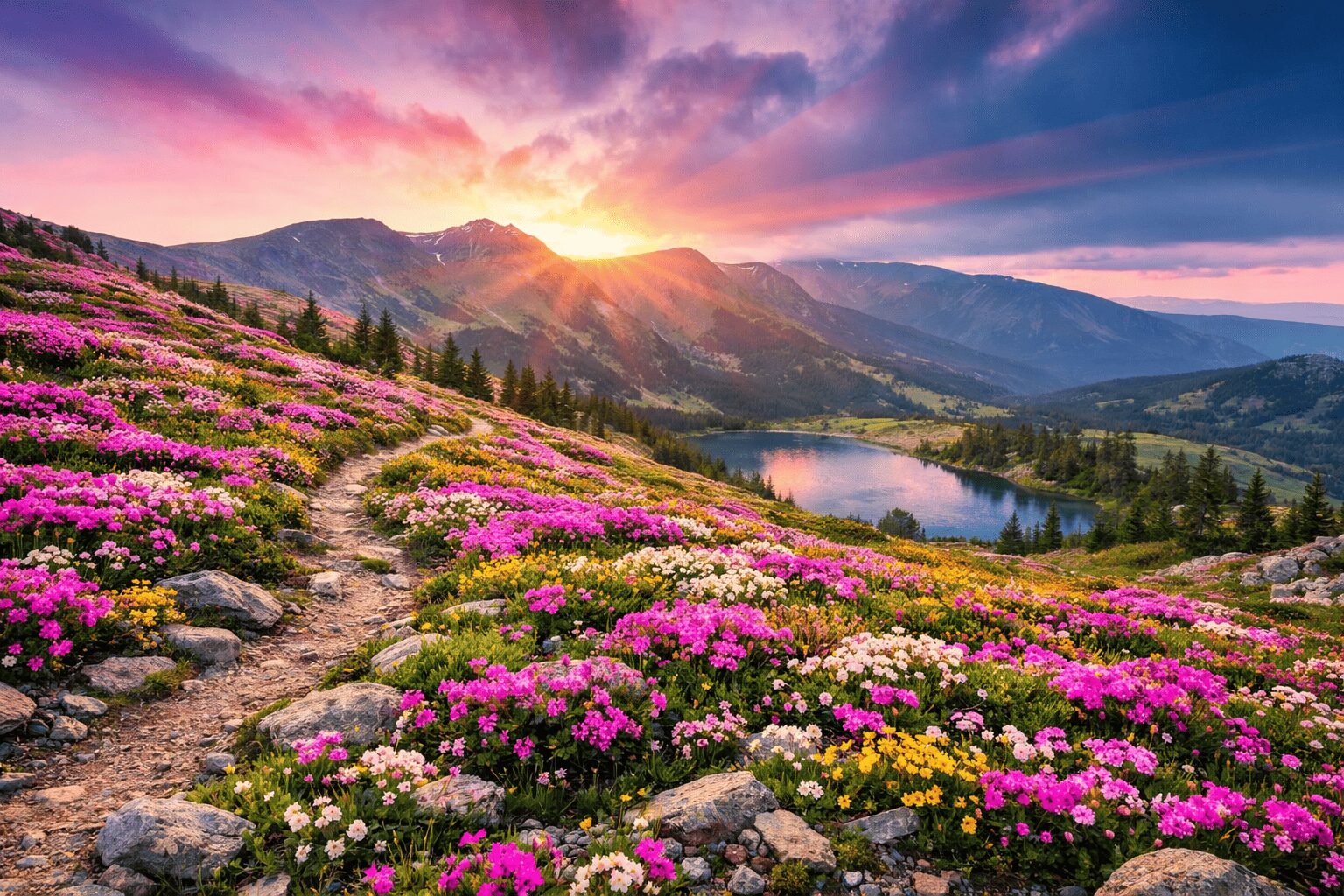
| DIRECT ANSWER: The Valley of Flowers National Park (Phoolon ki Ghati) in Chamoli district, Uttarakhand, is widely considered India’s most beautiful trek — a UNESCO World Heritage Site since July 14, 2005, home to 520+ alpine plant species, rare Himalayan wildlife, and the sacred Hemkund Sahib Gurudwara. The best time to visit is mid-July to early September, starting from Govindghat on a ~38 km round-trip moderate trek. |
| Attribute | Detail |
| Official Name | Valley of Flowers National Park |
| Alternate Names | Phoolon ki Ghati, Flower Valley Himalayas |
| Location | Chamoli District, Garhwal Region, Uttarakhand, India |
| Coordinates | 30.72°N, 79.61°E |
| UNESCO Status | World Heritage Site (designated July 14, 2005) |
| Park Area | 87.50 km² (approx. 8 km long × 2 km wide) |
| Altitude Range | 3,200 m to 6,675 m above sea level |
| Valley Floor | 3,352 m to 3,658 m |
| Flora Count | 520+ plant species (Forest Research Inst., 1992: 600 angiosperms) |
| Fauna | Snow leopard, Asiatic black bear, musk deer, blue sheep, red fox |
| Main River | Pushpawati River (originates from Tipra Glacier, Gauri Parbat) |
| Park Declared | 1982 (National Park); grazing banned 1983 |
| Park Open | June 1 – October 4 (approx.) |
| Entry Hours | 7:00 AM – 5:00 PM |
| Nearest Airport | Jolly Grant Airport, Dehradun (approx. 280 km) |
| Nearest Railhead | Rishikesh or Haridwar |
| Trek Start Point | Govindghat (~1,828 m / ~6,000 ft) |
| Trek Distance | ~38 km round trip |
| Best Season | Mid-July to early September |
| Part of | Nanda Devi Biosphere Reserve (223,674 ha) |
| Discovered By | Frank S. Smythe (British mountaineer), 1931 |
| Nearby Site | Hemkund Sahib Gurudwara (~4,329 m), ~10 km away |
Tucked into the Garhwal Himalayas of Uttarakhand, the Valley of Flowers National Park — locally known as Phoolon ki Ghati — is not just a trekking destination. It is a living, breathing canvas of alpine colour, a globally recognized biodiversity hotspot, and a place of deep spiritual significance. Here is why trekkers, botanists, photographers, and pilgrims from around the world make the journey every summer.
The Forest Research Institute’s 1992 survey documented over 600 species of angiosperms and 30 pteridophytes in the valley and its surroundings — 58 of which were recorded for the first time there. Botanist Prof. Chandra Prakash Kala, who spent a decade (1993–2003) researching the valley, personally documented over 520 diverse plant species, work that was instrumental in securing UNESCO designation in 2005.
The colour show changes approximately every few days through the peak monsoon blooming season (July to early September), as different species reach peak bloom at different altitudes across the valley’s three sub-alpine zones:
Notable species include the Blue Himalayan Poppy (Meconopsis aculeata) — a globally threatened plant recorded nowhere else in Uttarakhand outside this valley — the Brahma Kamal (Saussurea obvallata, Uttarakhand’s state flower), Cobra Lily, Aconitum falconeri, and the rare orchid Dactylorhiza hatagirea. Five of the six globally threatened plant species present here are not found anywhere else in Nanda Devi National Park.
| Expert Perspective: According to UNESCO’s World Heritage designation (Criterion x), the Valley of Flowers is internationally important for its diverse alpine flora representative of the West Himalayan biogeographic zone. Its location in the transition zone between the Zanskar and Great Himalaya ranges — and between Eastern and Western Himalayan flora — creates a uniquely rich convergence of plant life found nowhere else. |
On July 14, 2005, UNESCO formally designated the Nanda Devi and Valley of Flowers National Parks as a combined World Heritage Site (WHC List #335). The site had originally been inscribed as Nanda Devi National Park alone in 1988; it was expanded and renamed in 2005 to include the Valley of Flowers and a larger buffer zone.
Both parks together form two core zones of the Nanda Devi Biosphere Reserve (223,674 ha), which is further surrounded by a buffer zone of 5,148.57 km². The entire Reserve falls within the Western Himalayas Endemic Bird Area (EBA) — a globally critical zone for avian biodiversity.
Conservation measures underpinning this status include a total grazing ban in effect since 1983, no permanent settlements inside the park, and a dedicated research nursery and seed/rhizome bank at Musadhar for propagating rare medicinal plants such as Picrorhiza kurrooa and Taxus wallichiana.
Unlike the technical difficulty of treks such as Roopkund (which reaches 5,029 m) or Chadar, the Valley of Flowers trek is rated moderate — making it one of the few UNESCO-listed Himalayan experiences genuinely accessible to fit first-timers. Here is what the standard itinerary looks like:
The valley floor itself spans approximately 5 km in length and 2 km in width. The entire park stretches over 87.50 km² at elevations ranging from 3,200 m to 6,675 m. No camping is permitted inside the valley; all visitors must enter after 7:00 AM and exit by 5:00 PM, with entry permits obtained at Ghangaria from the Uttarakhand State Forestry Department.
The Valley of Flowers and the adjacent Nanda Devi National Park together provide protected habitat for some of the Himalayan ecosystem’s most threatened mammals. The valley’s diverse microhabitats — valley bottom, river bed, meadows, moraines, bogs, and cave zones — support an exceptional range of fauna.
Wildlife spotted (or recorded) in and around the park includes:
The valley is drained by the Pushpawati River, which originates from the Tipra Glacier on Gauri Parbat — a glacial-fed system that sustains the valley’s moisture-rich ecosystem through the summer months.
The Valley of Flowers carries profound cultural and spiritual weight extending well beyond its ecology. In Hindu tradition, it is believed to be the place where Hanuman gathered the Sanjeevani herb to revive Lakshmana in the Ramayana — lending the valley an almost sacred aura long before modern tourism discovered it.
Just 10 km to the south lies Hemkund Sahib, a revered Sikh Gurudwara and pilgrimage site set at 4,329 m beside a glacial lake surrounded by seven snow-capped peaks. It draws hundreds of thousands of pilgrims each summer, making the combined trek one of India’s most spiritually resonant journeys.
The valley’s modern history begins with British mountaineer Frank S. Smythe, who — along with Eric Shipton and R.L. Holdsworth — stumbled upon it in 1931 while returning from a successful expedition to Mount Kamet. Smythe later wrote a book simply titled Valley of Flowers. In 1939, Joan Margaret Legge, a botanist deputed by the Royal Botanic Gardens, Kew, arrived to study the flora — and tragically died in the valley while collecting specimens. The valley was formally declared a National Park in 1982.
Mid-July to early September is peak blooming season, coinciding with the monsoon. The park officially opens around June 1 and closes around October 4 each year. The valley is blanketed in snow outside this window and completely inaccessible.
| Feature | Valley of Flowers | Roopkund Trek | Kedarkantha Trek |
| UNESCO Listed | Yes | No | No |
| Best Season | Jul–Sep | May & Sep | Dec–Apr |
| Max Altitude | ~3,658 m | ~5,029 m | ~3,810 m |
| Difficulty | Moderate | Difficult | Easy–Moderate |
| Floral Diversity | 500+ species | Limited | Moderate |
| Spiritual Site Nearby | Hemkund Sahib | Roopkund Lake | Kedarnath (nearby) |
| Wildlife Spotting | High | Moderate | Low |
| Camping Allowed | No (day visits) | Yes | Yes |
Mid-July to early September is the prime window, when monsoon rains trigger peak blooming across all 500+ species. The park is closed from approximately October to May due to heavy snow.
No — it is rated moderate. The base camp at Ghangaria (3,049 m) is reachable by a well-maintained 14 km path from Govindghat, and the valley itself sits at 3,352–3,658 m. Fit beginners with no prior Himalayan experience can complete it comfortably.
The standard route from Delhi is: Delhi → Haridwar or Rishikesh (by train or road, approx. 250 km) → Joshimath → Govindghat (by road) → Ghangaria (14 km trek) → Valley of Flowers (8 km trek). The full road journey from Rishikesh to Govindghat takes around 10–12 hours.
No. Camping is strictly prohibited inside the national park. All trekkers must stay in Ghangaria (the nearest village with guesthouses and camping facilities) and make day trips into the valley.
They are separate but commonly combined into one itinerary. Valley of Flowers is a national park approximately 8 km from Ghangaria. Hemkund Sahib Gurudwara is a separate 12 km round-trip day trek from Ghangaria, located about 10 km south of the valley at 4,329 m.
Documented species include the snow leopard, Asiatic black bear, brown bear, Himalayan musk deer, blue sheep (bharal), red fox, and Himalayan monal pheasant. The snow leopard is extremely elusive; musk deer and bharal sightings are more common.
Yes. The valley is traditionally identified with the place in the Ramayana where Hanuman collected the Sanjeevani herb to revive Lakshmana. Indian yogis are also documented to have visited the valley for meditation since ancient times.
| Prof. Chandra Prakash Kala’s decade-long research (1993–2003) at the valley — published in peer-reviewed journals and cited in the UNESCO nomination — remains the most authoritative scientific study of the valley’s biodiversity. His documentation of 520+ plant species was the scientific foundation for WHC inscription in 2005. |
The valley’s conservation significance is formally recognised by three international bodies: UNESCO (World Heritage Site), the IUCN (Biosphere Reserve network), and the Convention on Biological Diversity — making it one of the most internationally validated natural sites in South Asia.
The Uttarakhand State Forestry Department, the nodal government body administering the park, restricts development, enforces entry quotas, and maintains research plots to monitor invasive species such as Himalayan knotweed (Polygonum polystachium) — a proactive, science-led management model.
Entry fees are set by the Uttarakhand Forest Department and are subject to annual revision. As of recent seasons, Indian nationals pay a nominal fee per day; foreign nationals pay a higher rate. Obtain your permit at the checkpoint in Ghangaria — not at Govindghat. Check with the Uttarakhand Tourism official website or your trekking operator for current rates.
Yes, the trail from Govindghat to Ghangaria is well-maintained, frequently traversed by pilgrims going to Hemkund Sahib, and monitored by forest department personnel. Solo trekking is common; however, during monsoon, landslide risk on certain sections requires caution and up-to-date trail condition checks.
Valley of Flowers is best for floral diversity, moderate terrain, and UNESCO heritage value — ideal for nature lovers and beginners. Roopkund is a more physically demanding trek reaching 5,029 m, focused on the mystery of its skeletal lake and mountain landscapes. Both are spectacular; choice depends on fitness level and primary interest.
Absolutely — and most travellers do. Badrinath Dham, one of the four Char Dham pilgrimage sites, is just 23.9 km from Govindghat, making it a natural add-on to any Valley of Flowers itinerary.
The Valley of Flowers National Park is the rare intersection of ecological rarity, moderate accessibility, spiritual depth, and global recognition. With over 520 plant species, five globally threatened plants found nowhere else in Uttarakhand, UNESCO World Heritage designation since July 14, 2005, and proximity to the sacred Hemkund Sahib Gurudwara, it earns its title as India’s most beautiful trek on every front.
Whether you are a first-time trekker, a seasoned botanist, a wildlife photographer, or a pilgrim, the valley offers something irreplaceable — a living landscape that changes colour every few days through summer, and stays with you long after you have come down from the mountains.
Trek it. Photograph it. Protect it.
©Famous India Blog. All rights reserved.
Creativity By Needinfotech