


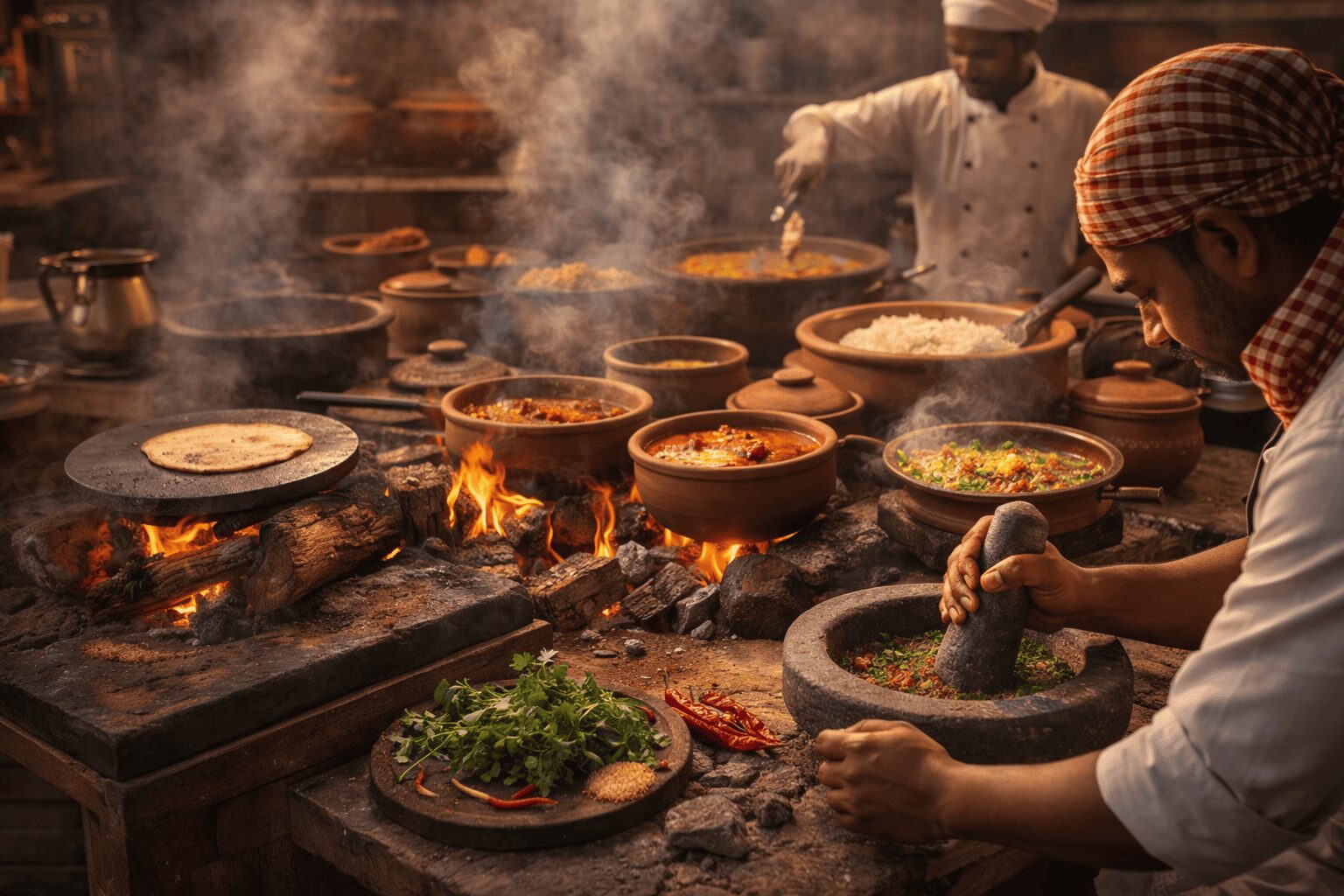
| DIRECT ANSWER: Mumbai kitchens are reviving ancient Indian cooking techniques — including clay pot (mitti ka handi) cooking, wood-fired chulha stoves, sil batta stone grinding, dum pukht, and traditional fermentation — driven by three forces: superior flavour, health consciousness, and sustainability. This movement spans home cooks, fine-dining restaurants like The Bombay Canteen (Lower Parel, Mumbai), and grassroots food platforms like The Locavore, founded by Chef Thomas Zacharias in 2022. |
| Attribute | Detail |
| City | Mumbai (Bombay), Maharashtra, India — Population ~20.7 million (2024 est.) |
| Culinary Identity | India’s most cosmopolitan food city; home to Maharashtrian, Parsi, Koli, Malvani, Bohri, East Indian, and Goan cuisines |
| Ancient Techniques Revived | Clay pot (handi/matka) cooking, Dum Pukht, Chulha (wood-fire), Sil Batta grinding, fermentation, banana-leaf cooking |
| Key Traditional Vessels | Mitti ka handi (clay pot), sil batta (stone grinder), matka (clay water pot), khapar (flat earthen tawa), brass/copper/bronze utensils |
| Roots of Tradition | Indus Valley Civilisation (c.3000 BCE) — some Indian cooking styles documented for ~5,000 years |
| Chulha Temperature | Traditional clay tandoor/chulha reaches up to 480°C (900°F) |
| Dum Pukht Origin | Awadh (present-day Lucknow), Uttar Pradesh — made famous by Nawabi royal kitchens |
| Key Chef | Thomas Zacharias (Chef TZac) — ex-Chef Partner, The Bombay Canteen, Mumbai; Founder, The Locavore (2022) |
| Relevant Institutions | The Bombay Canteen (Lower Parel, Mumbai), The Locavore platform, Local Food Club (Mumbai) |
| Health Drivers | Ayurvedic alignment, probiotic benefits of fermentation, alkalinity of clay-cooked water, antimicrobial copper/brass |
| Sustainability Link | Clay and wood are renewable; traditional cookware reduces plastic, synthetic coatings, and fossil fuel dependency |
| Market Access | Crawford Market (Mumbai), Dharavi artisans, Dadar farmers’ market, Mahalaxmi heritage craft stores |
| Challenges | Space constraints in Mumbai apartments, time intensity, declining generational knowledge, niche market availability |
| Revival Formats | Home kitchens, pop-up dinners, food festivals, culinary school curricula, Instagram storytelling series |
Mumbai (formerly Bombay), Maharashtra’s capital and India’s financial hub, is a city of contrasts: cloud kitchens and chulhas, instant noodles and hand-ground masalas, Michelin-worthy tasting menus and clay-pot biryanis from a century-old family recipe. With a population of over 20.7 million across Greater Mumbai, it is also a city where food is identity.
Since roughly 2018–2020 — accelerated significantly during the COVID-19 lockdowns of 2020–2021 when Mumbaikars were confined to their homes and reconnecting with food memories — a measurable revival of ancient Indian cooking techniques has been underway. It is not nostalgia alone. It is driven by science, sustainability, and the search for authentic flavour in a hyper-processed food landscape.
Some of these techniques — clay pot cooking, stone grinding, open-fire chulha cooking — trace their origins to the Indus Valley Civilisation (c.3000 BCE), making them among the oldest continuously practised culinary traditions on Earth.
The revival is not a single trend — it is the convergence of four distinct forces happening simultaneously across Mumbai’s diverse neighbourhoods, from Bandra and Khar in the west to Dharavi, Dadar, and Colaba in the south:
A clay handi, a wood-fired chulha reaching up to 480°C, or a sil batta grinding fresh masala produces flavours that blenders, non-stick pans, and induction stoves demonstrably cannot match. The slow, even heat of clay releases mineral compounds into food. Stone grinding releases essential oils from spices and garlic that high-speed blenders oxidise and destroy. Wood smoke creates the Maillard reactions responsible for the deep, complex aroma of traditional dal, roti, and meat dishes. Chefs and home cooks across Mumbai consistently cite this flavour superiority as the primary reason for returning to old tools.
Mumbai’s urban professionals — particularly millennials and Gen Z — have become acutely aware of what their cookware adds to (or removes from) their food. PTFE-coated non-stick pans release toxic fumes at high temperatures. Aluminium cookware has been linked in some studies to heavy metal accumulation. Processed foods lose micronutrients. In contrast, clay pots are alkaline, naturally raising the pH of cooked food. Copper and brass utensils have documented antimicrobial properties used in Ayurvedic medicine for thousands of years. Fermented foods — kanji, traditional dosa and idli batters, achaar — boost gut microbiome diversity in ways that commercially processed alternatives do not.
Clay, stone, wood, and bronze are fully renewable and biodegradable materials. They require no synthetic manufacturing processes, no plastic packaging, and no imported fossil-fuel-derived coatings. For a generation of Mumbai residents increasingly aware of climate impact, choosing a mitti ka handi over a Teflon-coated pan is both a personal health decision and an environmental one. Traditional clay chulhas use locally sourced biomass fuels — wood, dried leaves, cow dung — aligning perfectly with today’s circular economy principles.
India’s rapid urbanisation from the 1980s onward meant that millions of families relocated from villages and smaller towns to cities like Mumbai, often leaving behind cooking knowledge that was transmitted orally and practically — not from books. The grandmothers who knew how to season a sil batta, cure a clay pot, or judge a chulha’s heat by the sound of a dal are ageing. A growing number of young Mumbaikars — including second-generation migrants from Maharashtra, Kerala, Gujarat, Goa, and Konkan — are actively seeking to recover this knowledge before it is permanently lost.
Clay pot cooking — using the handi (deep vessel), matka (rounded pot), and khapar (flat earthen tawa) — is the single most visible revival across Mumbai. Restaurants in Bandra, Lower Parel, and Colaba now serve biryanis, dal makhani, and coastal curries specifically advertised as handi-cooked. At home, thousands of Mumbai families have returned to storing drinking water in matkas — the clay’s porous walls naturally cool the water through evaporation and increase its alkalinity, offering benefits no plastic bottle or refrigerator can match.
The science is straightforward: clay pots conduct heat slowly and evenly, preventing scorching. Their micro-porous structure allows moisture to circulate inside the vessel, producing a self-basting effect that keeps meat tender and vegetables nutritionally intact. The mineral compounds in the clay — calcium, phosphorus, iron — leach slightly into the food during cooking, enriching it.
In Maharashtra’s Khandeshi cuisine — native to the Khandesh region along the Tapi River — the khapar is still used to make Mande (a regional form of puran poli). In Mumbai, this tradition, nearly invisible in the city for decades, is experiencing a quiet return through food festivals and home cook pop-ups.
Dum Pukht (from Persian: ‘to cook with breath/steam’) originated in the Awadhi royal courts of Lucknow (then Awadh), Uttar Pradesh, where Nawabi bawarchis perfected it over centuries for elaborate feasts. The method seals a heavy-bottomed pot — typically a brass or clay deg — with a thick rope of wheat dough (called ‘lagan’ or ‘atta seal’), then lets the food cook entirely in its own steam over a very low flame for several hours.
The result is unmistakable: meat falls off the bone, aromatic spices penetrate every fibre, and rice grains remain separate yet fully fragrant. The world’s most iconic dum pukht dish is biryani — and Mumbai, as a biryani capital with distinct Bohri, Hyderabadi, and Koli styles, is seeing this technique reclaimed not just by Mughlai restaurants but by home cooks and contemporary chefs experimenting with jackfruit, paneer, and seafood variations.
The chulha — a clay or brick-built open-fire stove fuelled by wood, cow dung cakes, or dried crop residues — has been the centrepiece of Indian rural kitchens for millennia. Traditional chulhas are typically built from locally sourced clay, sometimes reinforced with brick, and designed to trap heat efficiently while cooking food slowly and evenly.
A traditional tandoor (a cylindrical variant of the chulha) reaches temperatures of up to 480°C (900°F) — far beyond what any domestic gas or electric stove can achieve. This intense dry heat produces the charred exterior and moist interior of tandoori naan, chicken tikka, and seekh kebab that is genuinely irreproducible by modern appliances.
In Mumbai, the chulha revival takes several forms: urban pop-up cafes in Versova and Byculla that offer chulha-cooked Maharashtrian thalis; food festival stalls at events like the Kala Ghoda Arts Festival and Mumbai Street Food Festival; and a growing number of households — particularly in Dharavi, Kurla, and Mulund — that maintain a small mitti chulha for festive cooking. Several artisan brands now sell compact, apartment-friendly clay chulhas online, shipped across Maharashtra and nationally.
The sil batta — a flat granite grinding stone (sil) paired with a smaller cylindrical rolling stone (batta) — is one of the oldest kitchen tools on the Indian subcontinent, with examples found at Indus Valley Civilisation excavation sites dating to approximately 3000 BCE.
Unlike electric blenders, which spin at high RPM and generate heat that oxidises essential oils and alters the chemical structure of fresh ingredients, the sil batta works through low-speed pressure grinding. The result is a fundamentally different product: chilli-garlic paste ground on stone has a coarser, more complex texture; coconut chutney retains a natural creaminess; and freshly ground garam masala releases a bouquet of aromatic compounds that pre-ground powder or blender-processed spice cannot achieve.
Several Mumbai-based culinary workshops — run by home cooks and community food educators in Dadar, Matunga, and Vile Parle — now include sil batta sessions as part of broader programmes in traditional Maharashtra, Goan, and South Indian cooking.
Fermentation is arguably India’s oldest food preservation and health technology. Long before probiotics became a global wellness category, Indian kitchens were producing kanji (a fermented black carrot or beetroot drink, particularly from Rajasthan and Punjab), traditional dosa and idli batters (fermented for 8–12 hours), sol kadhi (Kokum and coconut milk ferment of the Konkan coast), and a vast array of achaar (pickles) and papad (sun-dried lentil wafers).
Mumbai’s Konkan-origin communities — Malvani, Goan Catholic, and East Indian (the Catholic community of the Mumbai region, not a directional descriptor) — have maintained fermentation traditions more consistently than other urban groups. Their revival is now spreading: sol kadhi has become a fixture on Mumbai restaurant menus; home fermentation kits for dosa batter, kanji, and kombucha-adjacent traditional drinks are sold at markets like Crawford Market and Matunga’s Tamil quarter.
Before stainless steel and aluminium industrialised Indian kitchens in the mid-20th century, brass (peetal), copper (tamba), and bronze (kansa) were the dominant cookware materials in Indian households for over 3,000 years. Each has documented properties: copper has antimicrobial action (oligodynamic effect) validated in multiple laboratory studies; brass is corrosion-resistant and imparts trace zinc to food; bronze (bell metal, widely used in Kerala and Odisha) produces a distinctive mineral note in food.
Mumbai’s Dharavi — Asia’s largest informal urban settlement and a major artisan manufacturing hub — houses skilled metal craftspeople who produce traditional brass and copper cookware using ancestral techniques. The revival of traditional metal cookware is creating direct economic benefit for these artisans, connecting urban Mumbai’s wellness-driven demand to Dharavi’s craft heritage.
| Expert Perspective: Chef Thomas Zacharias (known as Chef TZac), a Culinary Institute of America (CIA, Hyde Park, New York) graduate who trained at Le Bernardin — a three-Michelin-star restaurant in New York City — returned to India in 2014 and took over as Chef Partner at The Bombay Canteen in Lower Parel, Mumbai. After travelling through 18+ Indian states to document regional food traditions, he made it his mission at The Bombay Canteen to centre indigenous ingredients and ancient cooking techniques on a contemporary fine-dining menu. The restaurant was ranked No. 1 in India at the Condé Nast Traveller India Top Restaurant Awards in 2018. In 2022, Zacharias left the restaurant world and founded The Locavore — a platform dedicated to preserving India’s culinary heritage through storytelling, farmer partnerships, and the Local Food Club, which by mid-2025 had grown to 3,000+ members across 23 Indian cities, including five neighbourhood chapters in Mumbai alone. |
The Bombay Canteen (Lower Parel, Mumbai), founded in 2015 by restaurateurs Sameer Seth and Yash Bhanage alongside chef Floyd Cardoz, was among the first fine-dining establishments in India to make regional Indian ingredients and traditional cooking methods central — not peripheral — to its menu. Dishes inspired by Malvani coastal cuisine, Maharashtrian village food, and tribal recipes sourced from communities just 50 km outside Mumbai brought ancient techniques to the city’s most discerning diners.
Beyond fine dining, the revival lives in Mumbai’s cooking workshops, community food events, and social media. Chef Zacharias’s @ChefTZac Instagram series ‘Chef on the Road’ — which documented traditional cooking across villages in Gujarat, Himachal Pradesh, Sikkim, Nagaland, Jharkhand, and Maharashtra — directly influenced a generation of Mumbai home cooks to experiment with regional techniques. During the 2020 COVID-19 lockdown, his ‘Cooking with TZac’ video series covered over 17 regional Indian cuisines, reaching millions of viewers and sparking a wave of interest in traditional recipes among urban audiences.
The revival is not confined to restaurants. Across Mumbai’s residential neighbourhoods — from the chawls of Dharavi and Dadar to the apartment towers of Andheri and Powai — home cooks are making practical shifts:
The return to ancient methods faces real urban friction, and understanding these barriers is essential for anyone trying to adopt traditional cooking in a city like Mumbai:
| Feature | Ancient Methods (Clay, Chulha, Stone) | Modern Non-Stick/Electric | Microwave/Air Fryer |
| Flavour Depth | Exceptional — earthy, smoky, layered | Consistent but flat | Quick but surface-level |
| Nutritional Value | Higher — slow cooking preserves nutrients | Variable | Lower — high heat destroys nutrients |
| Environmental Impact | Low — clay, wood, natural materials | Moderate | Higher — synthetic coatings, plastic |
| Health Risk | Minimal — no toxic coatings | Moderate — non-stick risks at high heat | Low but synthetic-reliant |
| Cost | Low upfront, durable | High | Moderate |
| Time Required | Slow (intentional) | Fast | Fast |
| Cultural Value | Very High | None | None |
| Mumbai Availability | Dharavi, Crawford Mkt, online | Widely available | Widely available |
Mumbai kitchens are reviving clay pot (handi/matka) cooking, wood-fired chulha stoves, sil batta stone grinding, dum pukht (sealed steam cooking), traditional fermentation (kanji, dosa batter, achaar), and cooking in brass, copper, and bronze utensils. These methods trace their origins to the Indus Valley Civilisation (c.3000 BCE) and Awadhi royal kitchens.
Yes, for several documented reasons. Clay pots do not emit PTFE fumes (a risk with non-stick pans above 260°C), they add trace minerals to food, raise the alkalinity of cooked liquids, and cook food more slowly — preserving heat-sensitive B and C vitamins better than rapid high-heat methods. Copper and brass utensils additionally provide antimicrobial and mineral benefits.
Chef Thomas Zacharias (Chef TZac) is the most prominent figure. A CIA and Le Bernardin-trained chef, he served as Chef Partner at The Bombay Canteen (Lower Parel, Mumbai) from 2015, then founded The Locavore platform in 2022 to preserve India’s culinary heritage. His Local Food Club had over 3,000 members across 23 cities by mid-2025, with five Mumbai neighbourhood chapters. Community educators in Matunga, Dadar, and Vile Parle also run traditional cooking workshops.
Crawford Market (Mahatma Jyotiba Phule Market, South Mumbai), Dadar’s Phule Market, and artisan vendors in Dharavi are primary sources. Heritage homeware stores in Bandra and Khar stock premium versions. Several artisan brands also sell mitti chulhas, clay handis, and granite sil battas online with delivery across Mumbai, Pune, and nationally.
Dum pukht (Persian for ‘to cook with breath/steam’) is an ancient slow-cooking method originating in the Nawabi royal kitchens of Awadh (modern Lucknow, Uttar Pradesh). Food — typically meat, rice, or vegetables — is sealed inside a heavy pot with a dough lid and cooked entirely in its own steam over very low heat for several hours. The most famous dum pukht dish is biryani.
Kanji is a traditional North Indian probiotic drink made by fermenting black carrots, mustard seeds, and water for 2–3 days. Originally from Rajasthan and Punjab, it is rich in Lactobacillus bacteria and has been consumed for digestive health for centuries. Its rise in Mumbai is part of the broader fermented foods revival, driven by awareness of gut microbiome health.
Standard Mumbai apartments (typically 400–600 sq ft in mid-range housing) lack outdoor space for a traditional full-size chulha and have fire safety restrictions. Compact, apartment-friendly clay mini-chulhas (approximately 30 cm wide, 5 kg) are now commercially available and can be used on balconies or in well-ventilated kitchen areas. They are primarily used for festive cooking rather than daily meals.
The trajectory of Mumbai’s ancient cooking revival suggests a hybrid model is emerging — not a wholesale rejection of modern convenience, but a deliberate integration of traditional tools and techniques where they offer clear advantages in flavour, health, or cultural meaning:
Traditional full-size chulhas burning wood or cow dung produce carbon monoxide and smoke, making them unsuitable for closed indoor apartment spaces without ventilation. Compact clay mini-chulhas designed for urban use are safer for balcony or well-ventilated kitchen use, particularly for occasional festive cooking. Always ensure adequate airflow and never use in enclosed rooms.
New clay pots must be seasoned before first use: submerge in water for 12–24 hours, then dry completely. Rub the interior with a little oil and heat gently before first use. Always soak clay vessels in water for 15 minutes before cooking. Never place a dry clay pot directly on high heat, and avoid sudden temperature changes. Wash with warm water and a soft cloth — never soap, which blocks the pores.
Mumbai has several community-specific traditional foods made using ancient methods: East Indian (Catholic community of Greater Mumbai) bottle masala and rice bread (pao) use centuries-old spice blending and fermentation traditions; Koli (original fishing community of Mumbai) seafood dishes are traditionally cooked on open wood fires; Parsi community dhansak uses slow cooking in degchi pots; Malvani coastal curries from Konkan are traditionally made in clay pots with stone-ground coconut masala.
In most cases, yes. Clay, stone, brass, and copper require no synthetic manufacturing processes, contain no PTFE or plastic, and are fully biodegradable at end of life. Wood-fired chulha cooking uses renewable biomass. The primary environmental trade-off is that wood combustion produces particulate matter and CO2 — though far less per meal than the full lifecycle carbon footprint of producing, shipping, and disposing of synthetic cookware.
Mumbai’s revival of ancient cooking styles is not a rejection of modernity — it is a recalibration of values. In a city that moves faster than almost anywhere in India, a growing number of Mumbaikars are choosing to slow down in the kitchen: to grind on stone, cook in clay, ferment overnight, and fire with wood. They are doing so because the results — in flavour, in health, in cultural connection — are simply better.
From the clay pots of Dharavi’s artisans to the dum pukht dishes of The Bombay Canteen in Lower Parel; from Chef Thomas Zacharias’s grassroots Local Food Club to the Matunga housewife who gets out her grandmother’s sil batta on Sunday mornings — Mumbai’s ancient kitchen is not a museum exhibit. It is alive, evolving, and feeding a new generation.
©Famous India Blog. All rights reserved.
Creativity By Needinfotech